
No low-tech engineering succeeds if it ignores the transfer of economic and decision-making power to those who farm. The agroecological Hub puts the end of chores, land autonomy and women's governance at the heart of action — the kit (~€9,500) is only a lever.
AWAKEN DESTINY is a private Belgian humanitarian foundation (BCE no. 1016.499.721), supporting projects in Cameroon: food aid, schooling and empowerment — with this axis under study on the outskirts of Yaoundé (Angon).
Gouttes d'Avenir frees women's time through stored rainwater. Terres d'Avenir secures their right to exist on the land. Neither project is deployed on the ground yet.
People at the absolute forefront
In the equatorial forest belt, farming faces a sharpening climate paradox: rains of destructive intensity, then dry seasons stretching up to four months. But the real burden is not only agronomic — it is human. Rural women and girls carry the heaviest load: exhausting water-carrying chores to streams, health sacrificed, schooling interrupted, any hope of economic emancipation erased. Meanwhile fields lie bare while vegetable prices peak in Yaoundé.
AWAKEN DESTINY affirms a core conviction: no low-tech engineering, no irrigation tool, no agroforestry can succeed if it ignores the transfer of economic and decision-making power to those who farm the land. This document inverts the narrative pyramid — end of chores, land autonomy and women's governance first; the kit second.
Two projects under study embody that break: Gouttes d'Avenir (freedom through water) and Terres d'Avenir (dignity through land) — still in design and fundraising, not yet deployed.
The agronomic reality of Centre Cameroon
In Angon and around Yaoundé, the climate is bimodal equatorial: annual totals stay high, but rains are concentrated and violent, then give way to a dry season that can last up to four months. The local challenge is this distribution — not absolute aridity.
When ferralitic, lateritic and clay soils are left bare (slash-and-burn, intensive clearing), raindrop impact destroys surface micro-aggregates. Fine clay particles clog pores: the battering crust (croûte de battance), well known to Cameroonian agronomists and documented notably by IRAD. Without an adapted response, the water chore and bare earth reinforce each other.
Consequences of the battering crust
- Collapse of infiltration — even in heavy rain, water runs off, driving severe water erosion that strips the humus horizon.
- Root asphyxia and hardening — when the sun returns, the crust becomes a hard shell that blocks gas exchange and stops seedling emergence.
The Hub: water dignity on a right to exist
Funding water without securing the right to use the land is nonsense — especially for women farmers exposed to dispossession. If the right to farm is contested the following year, both the funding and autonomy collapse. The Hub therefore links water liberation and tenure validation — without requiring a land purchase for every family.
In many Angon cases, the family already holds a plot. Gouttes d'Avenir (~€9,500) then equips the Hub: 200 m² of market gardening under 10 cm mulch and drip, fed by a buried 45 m³ masonry cistern. The foundation first verifies tenure strength — and places women at the centre of that formalisation — before any deployment.
When land is missing or the right of use remains too fragile, Terres d'Avenir complements the set-up: non-buildable acquisition or long-term leases registered for the benefit of women-managed cooperatives (order of magnitude ~€5,000 depending on the file). It is not a systematic prerequisite of the hydraulic kit.
Agroecological Hub — water to free, land to anchor (under study)
AWAKEN DESTINY project · status: under study — not yet deployed
| Strand | Role | Order of magnitude |
|---|---|---|
| Gouttes d'Avenir | Water lever: 40 m² impluvium shed, diverter, filter, 45 m³ cistern, pedal pump, drip, 10 cm mulch — in service of ending the chore | ~€9,500 / family |
| Tenure validation (prerequisite) | Ensure women farmers can stay on the plot — no compulsory purchase | Built into the diagnosis |
| Terres d'Avenir (if needed) | Acquisition or leases/titles for the benefit of women-managed cooperatives | ~€5,000 / typical file |
Five links: a liberation lever
The Gouttes d'Avenir kit is not a hydraulic system for its own sake: it is a device to free women's bodies and time. Durable, locally repairable technologies with no fossil energy — 100% rainwater to protect aquifers and downstream rivers.
- Impluvium and first-flush diverter — catchment on the corrugated roof of a 40 m² farm shed (local timber frame). The first dirty litres fill a vertical float tube; once full, the float switches clean water to filtration, limiting silting of deep storage.
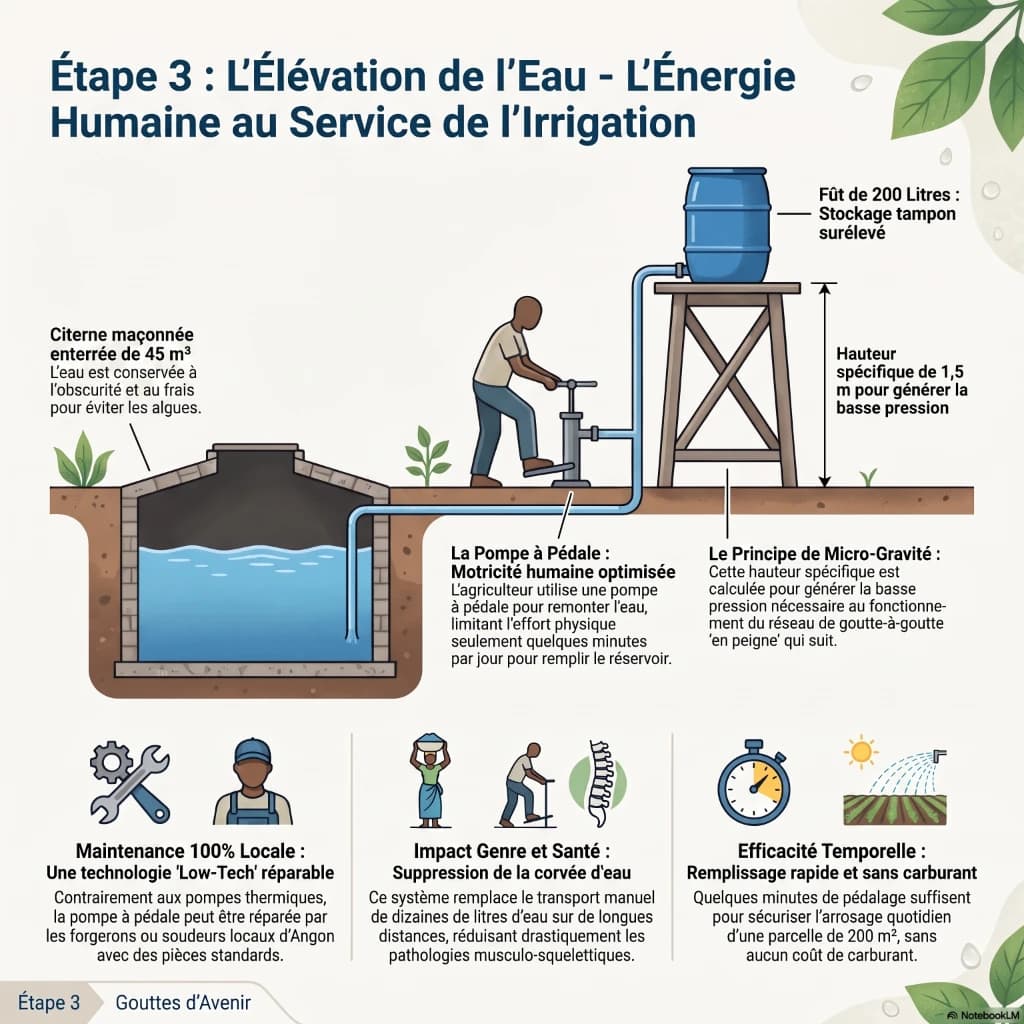
- Filtered underground reserve of 45 m³ — after a sand filter, water enters a buried masonry cistern (local blocks, waterproof mortar). Burying it means near-zero evaporation, darkness and coolness that curb algae and pathogens — clear water through the dry season.
- Pedal pump — the human link: in minutes on the plot, water rises to a 200 L buffer drum at 1.5 m. End of the carrying chore for women and girls — school can resume, health is preserved, farming becomes possible. Repairable by a local welder or blacksmith in Angon.
- Low-pressure comb drip network — from the drum, gravity plus a 130-micron screen filter; 32 mm PE main and surface laterals. Slow delivery at each plant's base: off-season tomatoes and chillies when prices peak in Yaoundé.
- Organic protective mulch — laterals stay on the surface (to avoid root intrusion) under 10 cm of biomass: UV protection for polymers and steady root-zone moisture.
The equatorial agroforestry tree: the Safou
In Centre Cameroon agroforestry systems, the Hub privileges indigenous trees suited to clay-lateritic soils and the degraded forest microclimate. Foremost is the Safou tree (Dacryodes edulis), already rooted in local practices and markets.
Why the Safou tree in the Hub
- Structure of clay-lateritic soils — deep roots improve vertical porosity and nutrient uplift.
- Filtered shade — protects tomatoes, chillies and sensitive crops from intense dry-season radiation without smothering the 200 m² garden.
- Direct economic value — safou (Cameroon plum), rich in lipids and essential amino acids, is highly sought locally: complementary income of which women keep control.
Risk management and contingency protocols
A credible funding dossier does not describe an idyllic scenario. To reassure risk committees, the Hub includes operational protocols that can be activated immediately.
Legal and tenure risk — in Cameroon, customary law and family conflicts particularly expose women to dispossession and eviction. Before any Gouttes d'Avenir kit, the foundation rejects verbal-only agreements: it documents and validates the right to farm, and registers leases or titles for the benefit of women-managed cooperatives when relevant. Land purchase is required only if the diagnosis shows it.
Climate risk — if rains are deficient, the 40 m² shed may not fill 45 m³. Continuing to irrigate 200 m² would empty the tank in two months. Proportional reduction protocol: at the end of the rains, measure storage; if the cistern is only ~50% full (~22.5 m³), cut drip area from 200 m² to 100 m² and concentrate water on highest nutritional and financial value crops — to protect a minimum income of which women keep control.
Governance and sustainability: the FIETS approach
Hub durability rests on the FIETS approach (Financial, Institutional, Environmental, Technical, Social), so the system keeps working beyond initial funding — under supervision of the AWAKEN DESTINY office in Yaoundé (Nkolmesseng), in synergy with the Belgian headquarters.
Once land and water are secured, a dual circuit applies: self-reliance (most production sold on local markets, income controlled by women farmers) and solidarity (surplus joins the foundation's food distribution for the most vulnerable).
| FIETS dimension | What the Hub plans | Human impact |
|---|---|---|
| Financial | Off-season margins (tomatoes, chillies, safou) + mandatory collective Solidarity Fund | Self-funded maintenance and an end to donation dependence |
| Institutional | Five-family pilot cluster, Water Pact, cooperative, pooled sales | Lasting transfer of decision-making and collective organisation |
| Environmental | 100% rainwater, mulch ≥ 10 cm, compost and local biopesticides (e.g. neem brew) | Restored soils without chemicals — lasting food and income |
| Technical | Gravity, local masonry, pedal pump — repair by Angon artisans | Local technical sovereignty, without industrial dependence |
| Social | Fund and tenure entrusted to women farmers: maintenance, schooling, community health | Equal access to income and legal sovereignty against dispossession |
What AWAKEN DESTINY does today
AWAKEN DESTINY is a private, non-political humanitarian foundation based in Belgium that funds and supports projects carried out in Cameroon (Yaoundé / Nkolmesseng) by the AWAKEN DESTINY association. Our supported work combines a vital safety net and empowerment — see also awakening a destiny.
Active programmes
- Food aid — emergency support for families in deep poverty.
- Economic empowerment — sewing workshop, soap-making, Comptoir d'Avenir.
- Education — homework school for children in difficulty or out of school.
Sources and references
This text draws on international frameworks and on AWAKEN DESTINY's operational framing in Cameroon — notably the Gouttes d'Avenir technical dossier (Angon) and the foundation's Impact Manifesto.
- FAO — Agroecology for the Sustainable Development Goals: principles and systemic applications.
- AWAKEN DESTINY — Gouttes d'Avenir technical dossier in Angon (Centre Cameroon): water resilience and off-season market gardening (project under study).
- AWAKEN DESTINY — Impact Manifesto: restoring human dignity through water and land (under study).
- IRAD (Cameroon) — Ferralitic soils, high kinetic-energy rainfall and battering-crust management in forest zones.
- IPES-Food — Sustainable food systems and agroecological transition.
- World Agroforestry Centre (ICRAF) — Dacryodes edulis (Safou): agroforestry potential and profitability in Central Africa.
Related reading