AWAKEN DESTINY
Awaken Destiny
All projects
04Water resilience · Angon

Gouttesd'Avenir

In Angon, Central Cameroon, the dry season stretches up to four months. Without water, there is no market gardening—and the burden falls mainly on women. We deploy a low-tech family kit that taps neither aquifers nor rivers: rainwater only.

Gouttes d'Avenir — water resilience and market gardening in Angon
The urgency in Angon

When the dry season settles in, women carry the water.

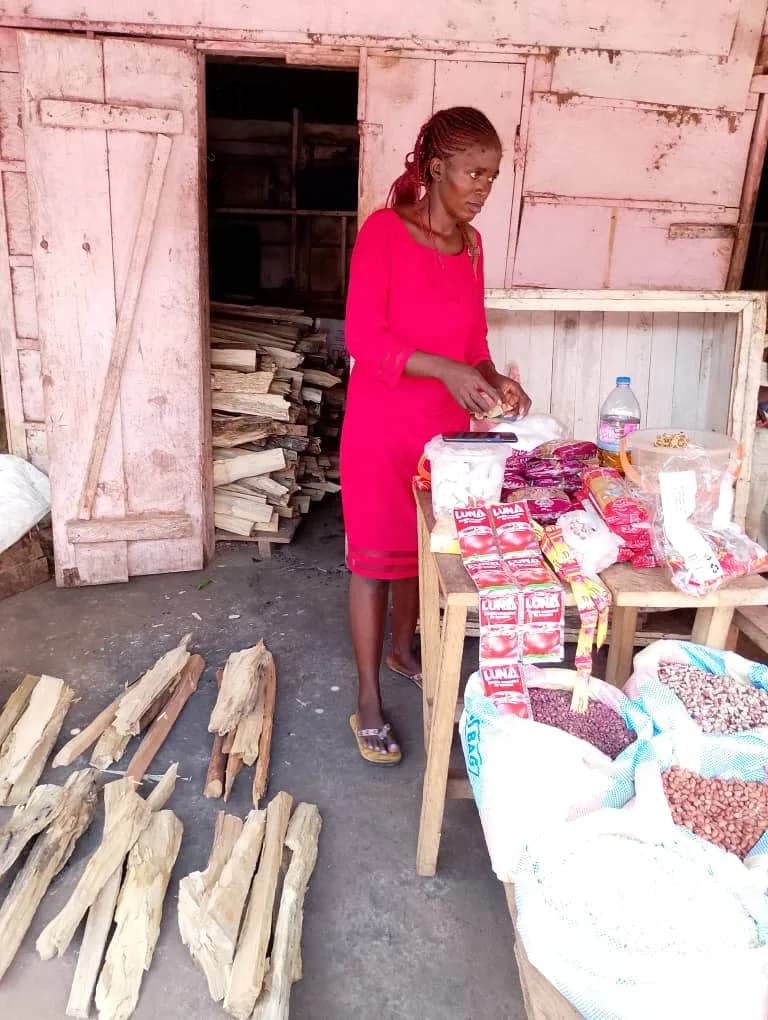
With no piped network or storage, irrigation means walking to streams and hauling dozens of litres. More than 80% of this chore falls on women and girls: musculoskeletal strain, time stolen from school and income-generating work.

For nearly four months, fields lie bare. Families lose food and income precisely when fresh vegetable prices peak. Thermal river pumping stays out of reach for small farms—and depletes downstream ecosystems. Gouttes d'Avenir refuses that dead end: harvest rainwater only, on every plot.

The solution

One family kit, five links

Each family receives a decentralised system that secures 200 m² of intensive dry-season gardening. Low-tech, locally repairable, zero pumping from natural water bodies.

Gouttes d'Avenir — rain catchment

Rain catchment — collect

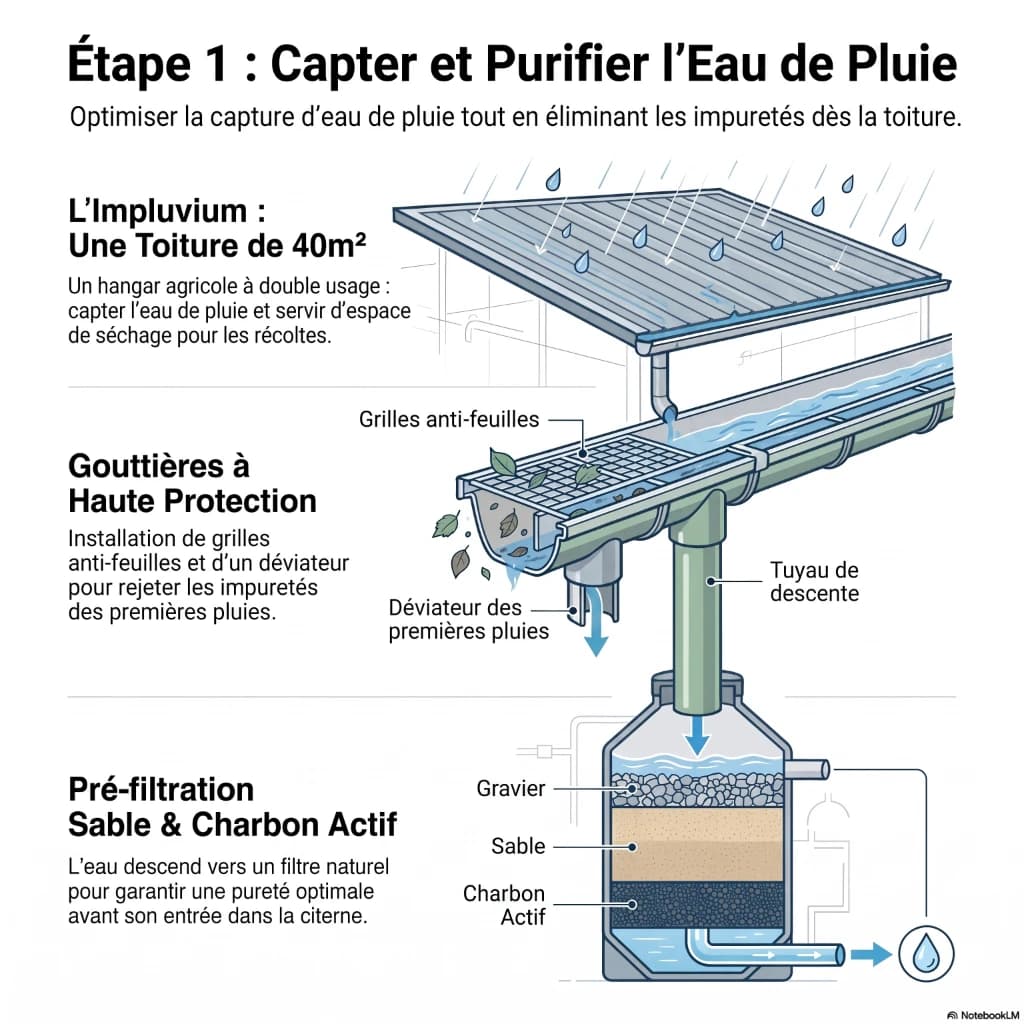
Collection starts with an agricultural shed of about 40 m²: metal roofing, local timber framing, and a drying space for harvests. Gutter screens catch leaves and debris before water enters the circuit.

A first-flush diverter automatically discards the first litres—the most loaded with dust and roof impurities. Only cleaner water then reaches the filter and cistern. No pumping from rivers or aquifers: 100% rainwater.
Gouttes d'Avenir — underground cistern

Underground reserve — store

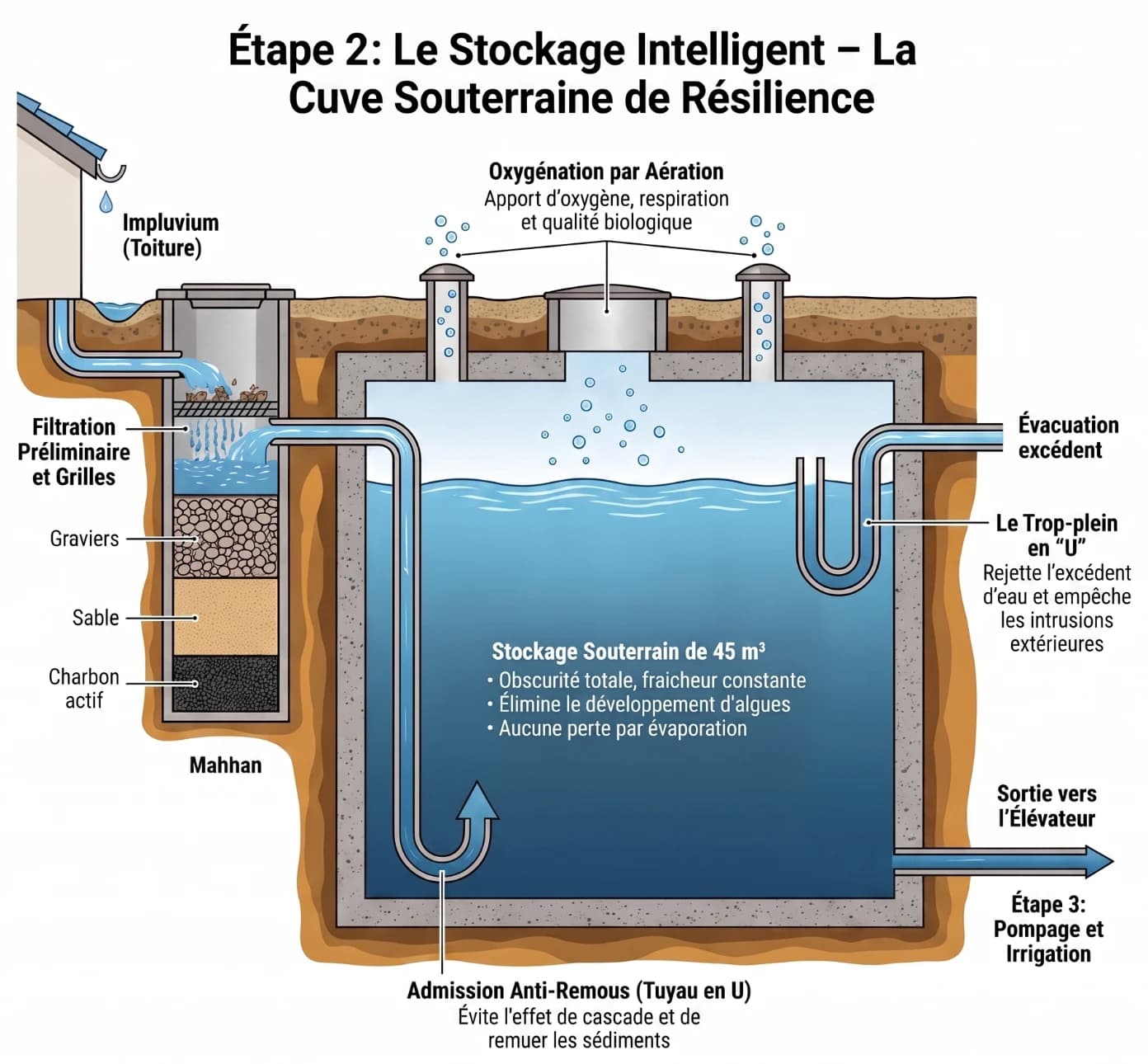
Water first passes through a sand filter that traps fine particles, then fills a buried masonry cistern of 45 m³, built with materials available in Angon and waterproof renders.

Burying the reserve keeps water cool, in total darkness (no algae bloom) and with almost no evaporation—critical when the dry season lasts up to four months. Each family owns its own tank: the resource is visible, measurable, and free of neighbour usage conflicts.

Gouttes d'Avenir — pedal pump

The elevator — lift

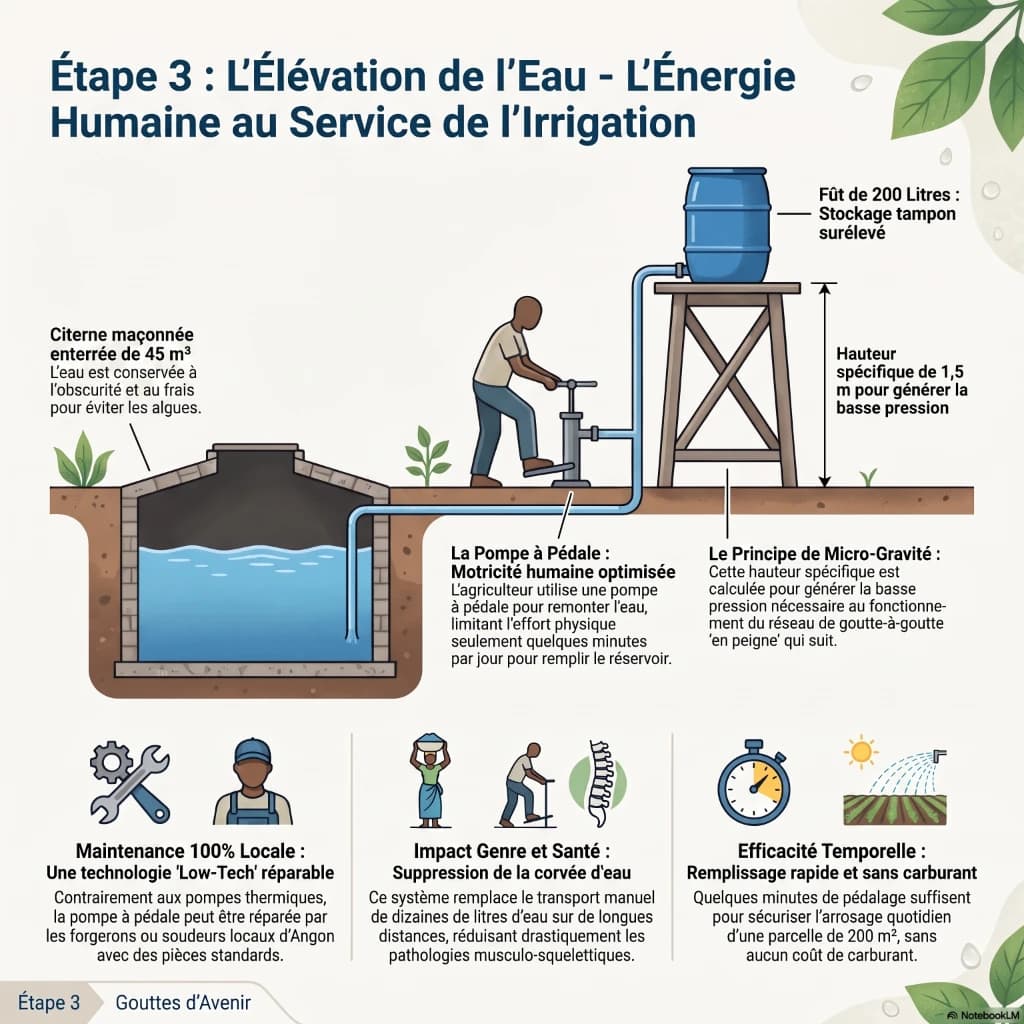
For gravity irrigation, water must rise from the buried cistern into a 200-litre drum set about 1.5 m high. A human-powered pedal pump does this in a few minutes a day, right on the plot.

The choice is deliberate: no thermal engine, no fuel, no imported spare parts that vanish from local markets. A blacksmith or welder can repair the pump with standard parts. Physical effort replaces carrying buckets hundreds of metres—without depending on external energy.

Gouttes d'Avenir — drip network

Drip network — distribute

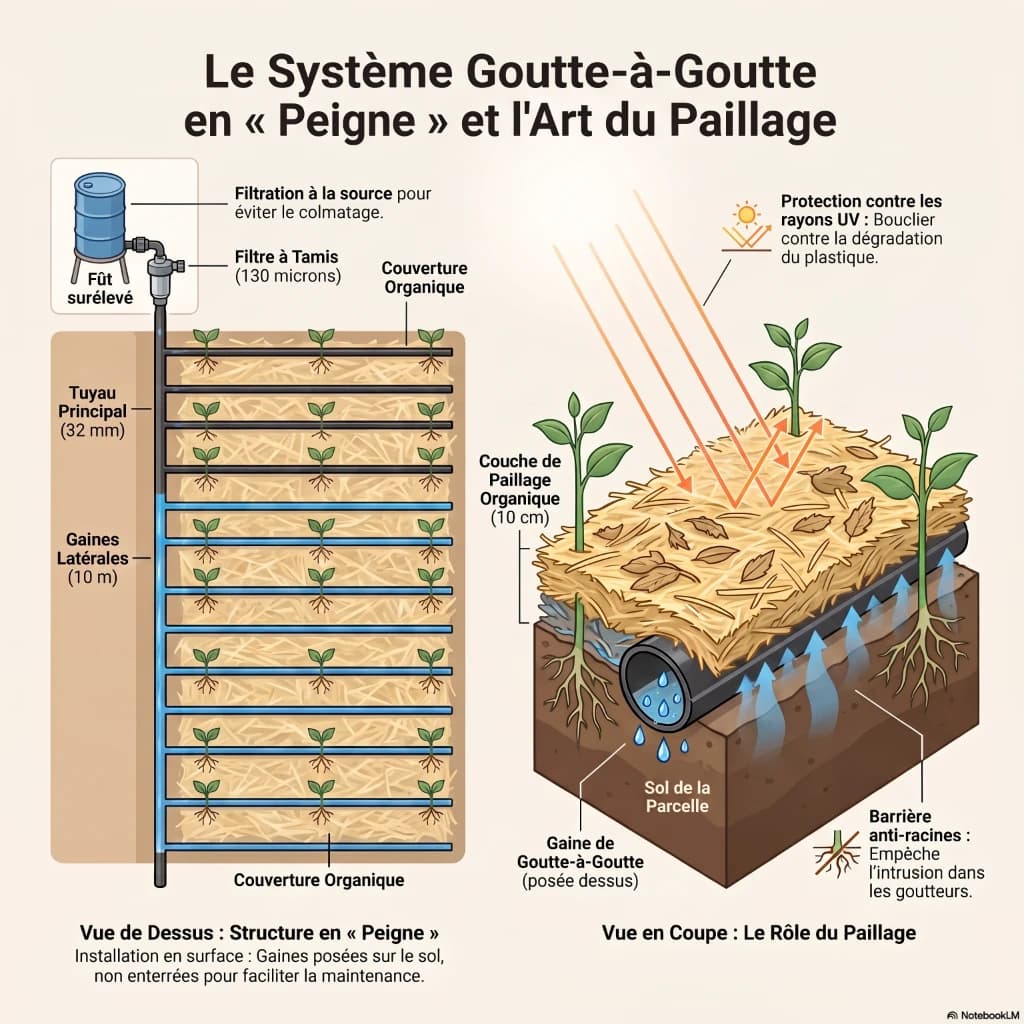
From the elevated drum, water passes a 130-micron screen filter that protects emitters from clogging, then feeds a low-pressure “comb” layout: a 32 mm main line serves horizontal drip tapes about 10 m long.

Flow is slow and targeted at the plant base: fewer losses, less competing weeds, and irrigation suited to 200 m² of intensive gardening. Tapes are not buried—they rest on the soil under mulch, which limits root intrusion into emitters and makes inspection and repair easier.

Gouttes d'Avenir — mulching

Mulching — protect

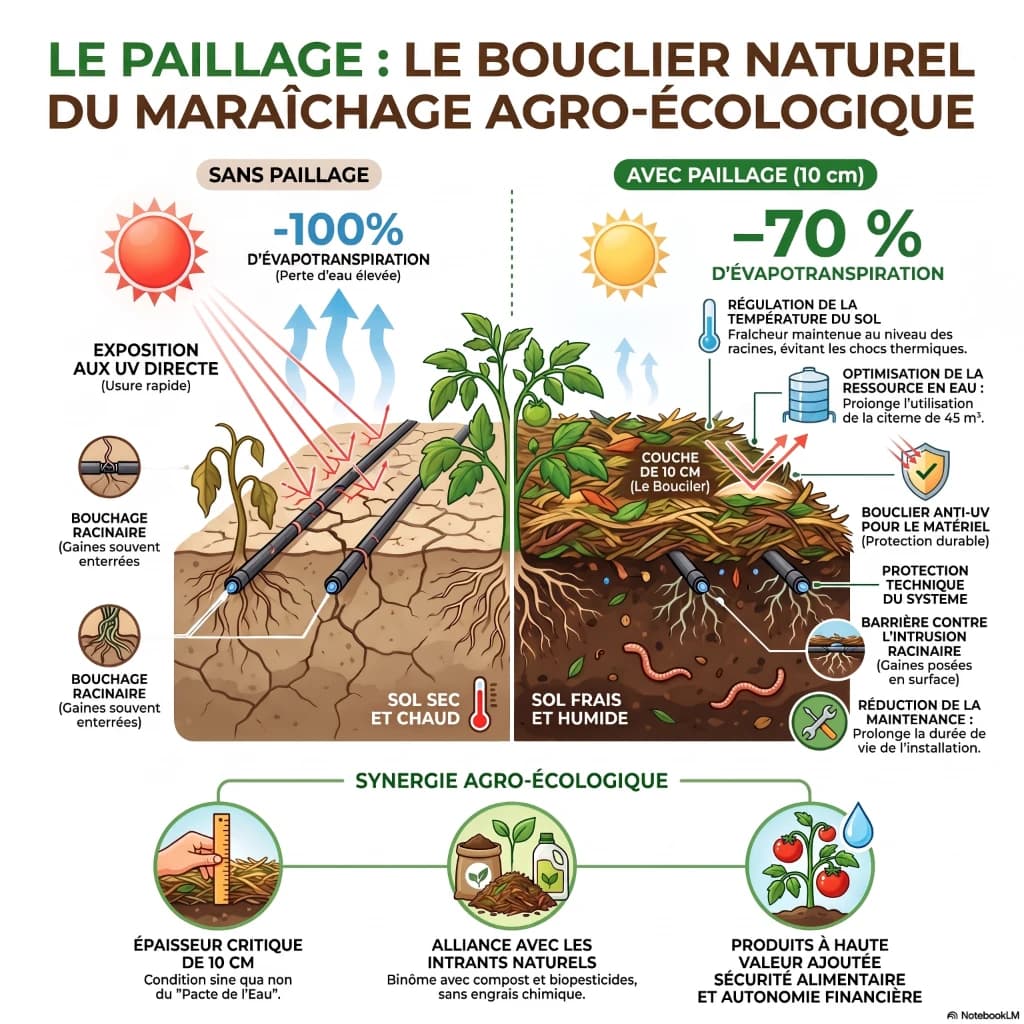
About 10 cm of organic mulch covers the tapes and soil: it shields plastic from UV, slows evaporation (by up to 70% under the practices used here), and holds moisture through the dry season.

It is also a condition of the Water Pact: without permanent cover, the system loses efficiency. On the plot, local compost and biopesticides (e.g. neem brew) replace synthetic fertilisers and pesticides—keeping water, soil and income in the same virtuous loop.

Fund the pilot

A clear kit, a fund that lasts

The Family Autonomy Kit

€9,500

This amount fully equips one family for 200 m² of off-season gardening. It funds infrastructure—not a one-off handout.

  • Catchment shed (~40 m²), gutters and first-flush diverter
  • Buried 45 m³ masonry cistern and sand filter
  • Pedal pump, elevated 200 L drum and screen filter
  • Low-pressure drip network over 200 m²
  • Technical, agro-ecological and solidarity-fund training

The pilot cluster targets 5 families: about €47,500 in total for a replicable model in Angon.

Fund a complete kit

Governance

The Solidarity Fund

Infrastructure is individual so each household owns the responsibility. Governance is collective: the five families sign a “Water Pact” and form a cooperative.

A small share of dry-season vegetable sales feeds a Solidarity Fund managed by the women. It pays for wear parts, filters and pumps—without needing a new donation for every breakdown. Selling as a group also strengthens market prices.

Sustainability

Built to last

Beyond the funding year, the project follows the FIETS approach: five dimensions that secure family autonomy without creating dependency.

Financial

Sales of dry-season crops—when market prices peak—feed the Solidarity Fund for pump and filter maintenance.

Institutional

Families are organised as a cooperative, with ongoing support from Awaken Destiny Yaoundé, a recognised local partner rooted in Angon.

Environmental

Zero pumping from natural water bodies (100% rainwater). Soils protected by mulching, zero chemical inputs—local compost and biopesticides.

Technical

Exclusively low-tech: gravity, hand pumps repairable by local welders, masonry and materials available in Angon.

Social

Less heavy lifting for women’s health, and transparent management: each family visually monitors its own cistern.

The impact

What each kit changes

A measurable investment: less physical hardship, more food in the dry season, and a model the community can maintain on its own.

Gender

End of the water chore

On equipped plots, bucket-carrying for irrigation disappears: a few minutes of on-site pedal pumping frees women’s time and bodies.

Food

Off-season market gardening

Tomatoes, chillies and high-value vegetables when prices peak—food security and direct income managed by women.

Durability

A replicable model

Locally repairable low-tech, 100% rainwater, solidarity fund: the five-family pilot aims to be a showcase for the whole region.

Take action

What your investment truly irrigates

From a filter to a full kit: every amount equips a family in Angon to get through the dry season without pumping rivers.

€50

Filters and mulch

You contribute to sand and screen filters, and to the organic mulch that cuts evaporation on the plot.

€200

Pump or drip network

You fund a human-powered pump or a stretch of the low-pressure network that brings water to the roots.

€800

Civil-works contribution

You help build the buried cistern or the catchment shed—the heart of storage and collection.

€9,500

A complete Family Kit

You equip one family end to end: catchment, storage, pumping, irrigation and training. Five kits make the pilot cluster. For regular giving, the Circle of 5 (€5/month) also supports this work.

Prefer a different amount or monthly support? Every contribution, whatever its size, supports a family and equips a talent.

Invest
Invest in self-reliance

Through your investment, support and equip

Families in deep poverty, talents waiting to be equipped: every euro funds essential support and self-reliance in Cameroon. Join us from Belgium.

Invest
  • Secure payment

    Encrypted payment via a certified platform.

  • 100% tracked

    Every dollar is documented with rigor, without exception.

  • Measurable impact

    Concrete results, followed directly on the ground.

N° BCE 1016.499.72114, rue de Picardie, 6010 Charleroi, Belgium
Invest