Sending money to Cameroon from Europe: fees, delays, pitfalls (2026)
Advertised fees, FX margins, mobile money, express delays: what to compare before a Belgium or France → Cameroon transfer — with our free tools.
 David Herreman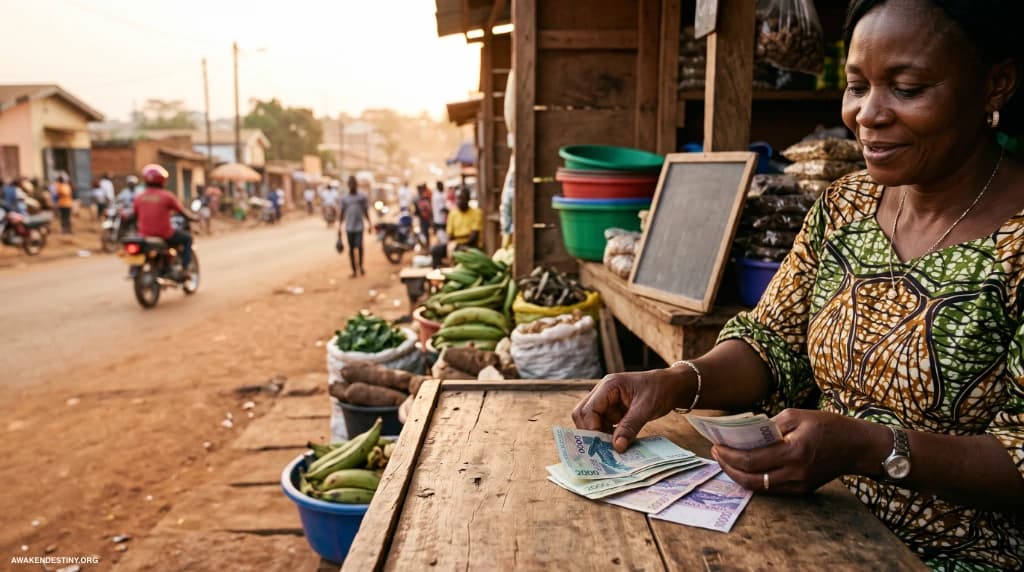
You live in Belgium, France or elsewhere in Europe, and you regularly send money to Yaoundé, Douala or elsewhere in Cameroon. In 2026, the question is no longer only “which operator?” — it is “how much actually arrives in CFA francs?”
According to the World Bank, sending money to Sub-Saharan Africa remains among the world’s most expensive corridors — often around 8% of the amount on average. On a €200 transfer, that is up to €16 that never reaches its destination. Over a year of family support, the gap between a well-chosen channel and a costly one adds up to hundreds of euros.
AWAKEN DESTINY is not affiliated with any transfer operator. We publish free tools and this practical guide to help you compare — not to sell you a product. Figures below are indicative order-of-magnitude (2026): always confirm the amount received with the operator before you confirm.
Compare now: our transfer fee comparator estimates the real cost (fees + FX margin) of a Europe → Cameroon transfer against the BEAC peg.
Why the real cost is not “€0 fees”
Three components almost always make up the cost of a transfer:
- Advertised fees — fixed, percentage-based, or both.
- The FX margin — the gap between the operator’s rate and the official BEAC peg: 1 EUR = 655.957 XAF.
- Receiving-side fees — withdrawal at a mobile money agent, counter commission, sometimes a minimum.
An operator can show “€0 fees” while converting at a rate far less favourable than 655.957. That is often where the real cost hides. The only figure that matters for your family: the final amount received in XAF.
Pedagogical example (indicative): if €200 at the BEAC peg would yield about 131,191 XAF, but the recipient only gets 125,000, the gap — fees + margin — is what the transfer really cost, well beyond the advertised “€0”.
To ground the maths:
- EUR/XAF converter — BEAC peg, market rate, conversion table.
- Article: EUR/XAF converter and BEAC peg.
The 4 channels to send money to Cameroon in 2026
1. Historic agencies (Western Union, MoneyGram, Ria…)
Dense network, fast cash pickup — useful if the recipient has no suitable phone or needs cash immediately. Often the most expensive channel at the counter, especially for small amounts and “express” options.
2. Transfer apps (Taptap Send, Remitly, WorldRemit…)
Generally more competitive than the counter. Many deliver straight to Orange Money or MTN Mobile Money. Check before you confirm: applied rate, amount received in XAF, announced delay, and sending-country conditions (Belgium, France…).
3. Mobile money on arrival (Orange Money, MTN MoMo)
This has become the most common way to receive money in Cameroon, including outside city centres. The recipient gets funds on their phone and withdraws at a neighbourhood agent. Watch-outs: possible withdrawal fees, wallet limits, and the correct recipient number.
4. Bank transfer
Suited to larger amounts or less urgent transfers. Slower, and it requires a bank account on both sides — which not every family in Yaoundé or Douala has.
We do not recommend one operator over another: compare the XAF received for your amount and delay. Our transfer fee comparator is built for exactly that.
Delays: express vs standard — when urgency costs the most
The “within minutes” option feels safe — and it is often the most heavily margined. If the need is not a medical emergency or an immediate deadline, a standard transfer (a few hours to one business day, depending on the channel) can save several euros — or several thousand XAF — for your family.
A useful reflex from Brussels, Paris, Lyon or Antwerp: plan ahead. A transfer scheduled early in the month often costs less than a Friday-night panic send.
On the receiving side, “already arrived” does not always mean “already withdrawn”. Mobile money credit can sit on a wallet while the family still needs cash for the market or school fees — factor in the time to reach an agent, especially outside Yaoundé or Douala.
Which pitfalls to avoid in 2026?
- The hidden rate — look at the amount received, not only the fees.
- Express by default — turn it off if you do not need it.
- Repeated small sends — five times €40 often costs more than one €200 (fixed fees).
- Peg vs market confusion — 655.957 is the official rate; the operator rate includes their margin. See the EUR/XAF converter.
- Forgotten withdrawal fees — ask the recipient what they actually get at the agent.
- Promos without the fine print — a “first transfer” offer can hide a worse rate later.
Checklist before you send
- Note the amount you pay in euros (all-in).
- Note the announced amount received in XAF.
- Compare to the BEAC peg (or via the converter).
- Check the real delay (express vs standard).
- Confirm the receiving method (MoMo, cash, account).
- Ask the recipient for the net amount after withdrawal.
- Re-run the comparison once a quarter — grids move.
For a quick send-side estimate: transfer fee comparator.
From family support to structural impact
Diaspora remittances are a pillar for millions of Cameroonian families. That support is irreplaceable — and it also has limits. A transfer answers this month’s emergency; it does not necessarily fund training, equipment or schooling over time.
That is the difference between supporting and equipping. To see what a small amount means on the ground — meals, rides, a day’s labour, basic care — use our Belgium → Yaoundé purchasing-power converter.
And to turn €5/month into traceable collective impact in Yaoundé: the Circle of 5 (and its impact simulator).
FAQ — sending money to Cameroon from Europe
How much does a Europe → Cameroon transfer really cost?
Often several percent of the amount, combining advertised fees and FX margin. The Sub-Saharan Africa average cited by the World Bank is around 8%, but your corridor (Belgium or France → Cameroon) and operator can do better — or worse. Compare the XAF received.
Can you send directly to Orange Money or MTN Mobile Money?
Yes. Most online transfer apps offer it. Check the rate, the delay, and any agent withdrawal fees.
What is the official euro / CFA franc rate?
655.957 XAF for 1 EUR (BEAC peg, CEMAC zone). Different rates shown by operators include their margin. Details: BEAC peg article.
How can you cut cost without taking risks?
Plan ahead instead of sending express, group small amounts, compare the amount received, and avoid cash-counter channels when an app + mobile money is enough.
Is AWAKEN DESTINY partnered with a transfer operator?
No. No affiliation. Our tools (comparator, converter, purchasing power) are free and independent — to inform the diaspora, not to steer you to a commercial offer.
Go further
- Transfer fee comparator — real cost vs BEAC peg
- EUR/XAF converter — rate and peg
- Yaoundé purchasing power — what €5 or €20 fund on the ground
- Cameroonian diaspora in Europe guide — send, help, support
- Cameroon in numbers — World Bank public context
- Circle of 5 — €5/month, collective impact in Yaoundé
Foundation based in Belgium · figures and examples for indication only (2026) · always verify with the operator before sending.
Support our work on the ground
Every donation equips concrete projects — essential support and self-reliance — in Cameroon.
Donate